Mountain talk has its own words: cols and cairns, half board and hut slippers, D+ and T3. This glossary explains the ones you will meet on the trail, in a hut and on our trip pages.
Tap a card to flip it and read the explanation. Search for a word, pick a category, or show all the answers at once.
Many of the words are French, German or Italian, because the Alps cross all three languages. Where a card lists other names, those are the words you will see on local signs and maps.
All words75 Hiking basics10 Mountain landscape12 Measuring a hike7 Difficulty & technique10 Huts & sleeping10 Gear12 Weather & safety8 Trail culture6
75 words
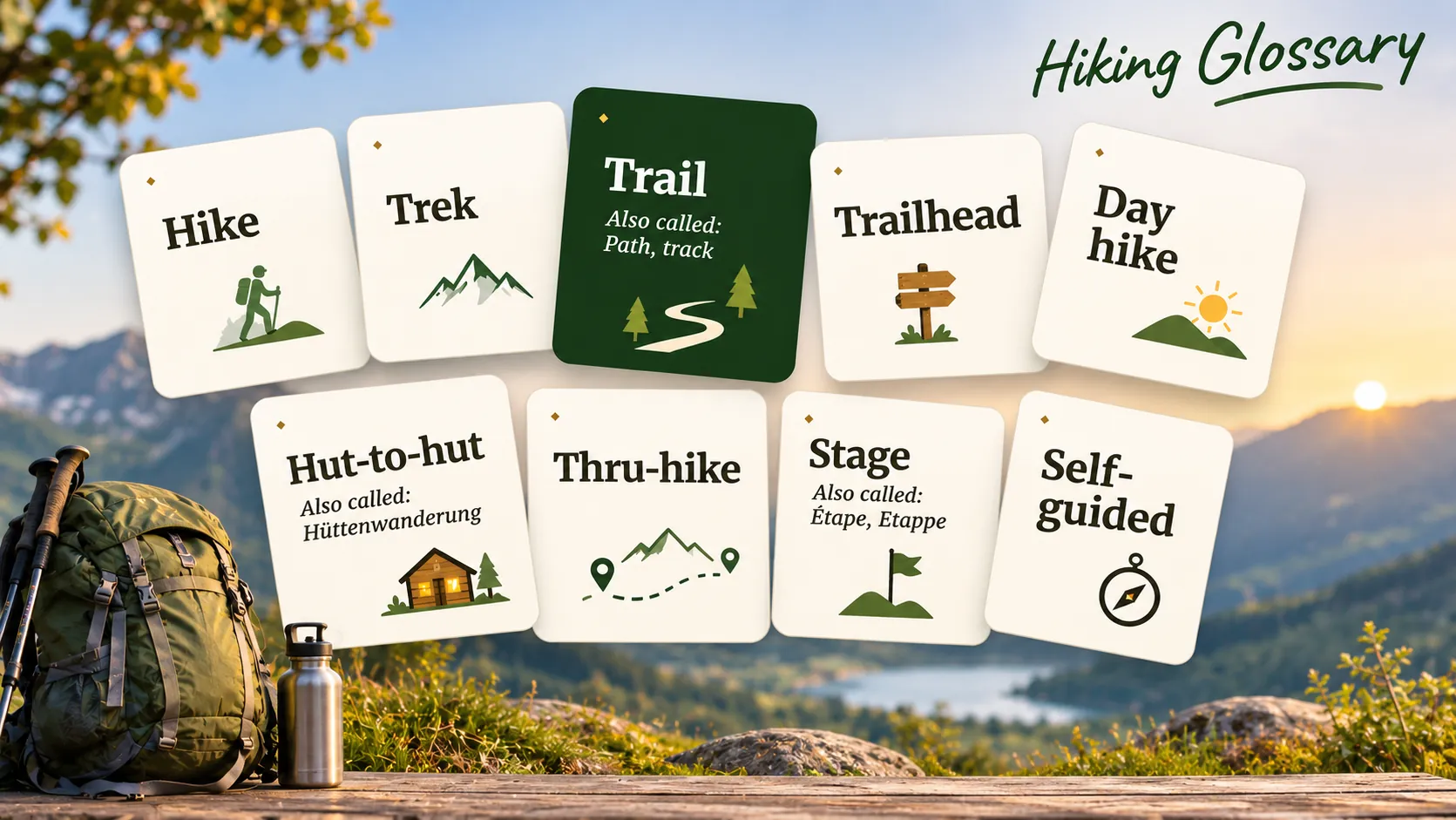
Hiking basics Hike Tap to flip 01/75 Hike A walk in nature, usually on a marked path, that is longer or steeper than an everyday stroll. Good to know: a hike can last an hour or a whole day. More than one day usually counts as a trek.Tap to flip back Hiking basics Trek Tap to flip 02/75 Trek A multi-day hike, usually from place to place, sleeping somewhere new each night. Example: the Tour du Mont Blanc is a 10 to 11 day trek around Mont Blanc.Tap to flip back Hiking basics Trail Also called: Path, trackTap to flip 03/75 Trail The marked route you follow. In the Alps trails are signposted at junctions with walking times to the next places. Good to know: signs show hours, not kilometres, because climbing changes everything.Tap to flip back Hiking basics Trailhead Tap to flip 04/75 Trailhead The point where a trail starts, often with a car park, bus stop or information board. Tip: fill your water bottles and use the toilet here. There may be none for hours.Tap to flip back Hiking basics Day hike Tap to flip 05/75 Day hike A hike you start and finish on the same day, carrying only a small daypack. Good first step: a few long day hikes are the best training for a multi-day trek.Tap to flip back Hiking basics Hut-to-hut Also called: HüttenwanderungTap to flip 06/75 Hut-to-hut A trek where you walk from one mountain hut to the next and sleep in a different hut every night. Example: our Venediger trek links three huts in four days.Tap to flip back Hiking basics Thru-hike Tap to flip 07/75 Thru-hike Walking a long-distance trail from end to end in one go, rather than in sections. Example: walking the whole TMB circuit instead of only the Les Houches to Courmayeur stretch.Tap to flip back Hiking basics Stage Also called: Étape, EtappeTap to flip 08/75 Stage One day's section of a multi-day trek, from one overnight stop to the next. Good to know: guidebooks split famous treks into standard stages, but you can combine or split them.Tap to flip back Hiking basics Self-guided Tap to flip 09/75 Self-guided You walk without a guide, following route notes, maps and GPS. Accommodation and logistics are arranged for you. At HikingFriends: self-guided includes training, GPS files and 24/7 phone support.Tap to flip back Hiking basics Circuit Also called: LoopTap to flip 10/75 Circuit A route that ends where it started. The opposite is a point-to-point route. Example: the TMB is a circuit, so you can start anywhere on it.Tap to flip back Mountain landscape Mountain pass Also called: Col (FR), Passo (IT), Joch (DE)Tap to flip 11/75 Mountain pass The lowest point on a ridge between two valleys, where a trail crosses from one side to the other. Example: the Grand Col Ferret (2,537 m) is the pass between Italy and Switzerland on the TMB.Tap to flip back Mountain landscape Summit Also called: Peak, topTap to flip 12/75 Summit The highest point of a mountain. Good to know: most trekking routes cross passes rather than summits. Summits often need climbing skills.Tap to flip back Mountain landscape Ridge Also called: Arête, GratTap to flip 13/75 Ridge A long, narrow crest of a mountain, often with steep drops on both sides. Example: the Mont de la Saxe ridge above Courmayeur faces Mont Blanc head on.Tap to flip back Mountain landscape Saddle Tap to flip 14/75 Saddle A broad, gentle dip between two high points. Like a pass, but rounder and easier. Tip: saddles make great lunch spots with views both ways.Tap to flip back Mountain landscape Glacier Also called: Gletscher, GhiacciaioTap to flip 15/75 Glacier A slow-moving river of ice formed from compacted snow over many years. Safety: never walk onto a glacier without a guide and rope. Hidden cracks (crevasses) are deadly.Tap to flip back Mountain landscape Moraine Tap to flip 16/75 Moraine Ridges and piles of rock and gravel pushed and left behind by a glacier. Good to know: moraine paths are loose and stony. Take your time on the way down.Tap to flip back Mountain landscape Scree Also called: Talus, GeröllTap to flip 17/75 Scree Slopes of small loose stones that slide under your feet. Tip: on scree, keep your weight over your feet and take short steps. Poles help a lot.Tap to flip back Mountain landscape Treeline Also called: TimberlineTap to flip 18/75 Treeline The altitude above which trees no longer grow. In the Alps it is around 1,800 to 2,200 m. Good to know: above the treeline there is no shade or shelter from wind and storms.Tap to flip back Mountain landscape Alpine meadow Also called: Alm, Alpage, AlpeTap to flip 19/75 Alpine meadow High grassy pastures where cows graze in summer, full of flowers in June and July. Tip: many Alms sell fresh cheese and milk to passing hikers.Tap to flip back Mountain landscape Balcony path Also called: Grand BalconTap to flip 20/75 Balcony path A trail that runs along a mountainside at a steady height, with wide views across the valley. Example: the Grand Balcon Sud above Chamonix, facing the Mont Blanc massif.Tap to flip back Mountain landscape Switchbacks Also called: Zigzags, lacetsTap to flip 21/75 Switchbacks A trail that zigzags up a steep slope, making the climb gentler. Trail rule: never cut corners. It erodes the slope and damages the path for everyone.Tap to flip back Mountain landscape Cirque Also called: Cwm, KarTap to flip 22/75 Cirque A bowl-shaped hollow at the head of a valley, carved by a glacier, often holding a small lake. Example: many alpine lakes like Lac Blanc sit in a cirque.Tap to flip back Measuring a hike Ascent Also called: Elevation gain, D+, Hm ↑Tap to flip 23/75 Ascent The total metres you climb up during a hike, added together over all the ups. Rule of thumb: most hikers climb about 300 to 400 metres per hour with a pack.Tap to flip back Measuring a hike Descent Also called: Elevation loss, D-, Hm ↓Tap to flip 24/75 Descent The total metres you walk down during a hike. Good to know: long descents are hard on knees and thighs. Poles take a lot of the strain.Tap to flip back Measuring a hike Altitude Also called: Elevation, m a.s.l.Tap to flip 25/75 Altitude Height above sea level, given in metres. Huts, passes and peaks are all marked with it. Example: Johannishütte sits at 2,121 m, Mont Blanc at 4,806 m.Tap to flip back Measuring a hike Walking time Also called: GehzeitTap to flip 26/75 Walking time The time an average hiker needs, not counting breaks. Alpine signs give it instead of distance. Tip: add about 25% for breaks, photos and lunch when you plan your day.Tap to flip back Measuring a hike Elevation profile Tap to flip 27/75 Elevation profile A graph showing how the trail climbs and drops over its length. Tip: check where the big climb comes. Morning climbs are cooler and safer.Tap to flip back Measuring a hike Contour lines Tap to flip 28/75 Contour lines Lines on a map joining points of the same height. Close lines mean steep ground. Tip: on most alpine maps, lines are 20 m apart. Count them to judge a climb.Tap to flip back Measuring a hike GPX file Also called: GPS trackTap to flip 29/75 GPX file A digital file of the route that you load into a hiking app or GPS watch to follow it. At HikingFriends: we send GPX files and offline maps for every trip.Tap to flip back Difficulty & technique SAC scale Also called: T1 to T6Tap to flip 30/75 SAC scale The Swiss Alpine Club grading for trails, from T1 (easy walking) to T6 (difficult alpine terrain). Guide: T2 to T3 is a normal mountain trail. Our Venediger trek reaches T4 on one pass.Tap to flip back Difficulty & technique Waymarks Also called: Trail blazesTap to flip 31/75 Waymarks Painted markings on rocks and posts that show the trail. In the Alps they are often red-white-red. Swiss colours: yellow for walking paths, white-red-white for mountain trails, white-blue-white for alpine routes.Tap to flip back Difficulty & technique Cairn Also called: SteinmannTap to flip 32/75 Cairn A small pile of stones used to mark the route where there is no path or paint. Trail rule: don't build your own cairns. They can lead other hikers the wrong way.Tap to flip back Difficulty & technique Fixed cables Also called: Chains, SeilsicherungTap to flip 33/75 Fixed cables Steel cables or chains bolted to the rock to hold on to on steeper or exposed sections. Good to know: on normal hiking trails you just hold them. No harness is needed.Tap to flip back Difficulty & technique Ladders Tap to flip 34/75 Ladders Metal ladders or rungs fixed to steep rock steps on some trails. Example: the ladders at Tré-le-Champ on the TMB. There is always an easier detour.Tap to flip back Difficulty & technique Scrambling Tap to flip 35/75 Scrambling Using your hands as well as your feet to climb over rocks, without ropes. Good to know: easy scrambling appears on some passes. Proper climbing needs ropes and skills.Tap to flip back Difficulty & technique Via ferrata Also called: KlettersteigTap to flip 36/75 Via ferrata A protected climbing route with cables, rungs and bridges, done with a harness and special lanyards. Safety: this is not hiking. You need the right gear and experience, or a guide.Tap to flip back Difficulty & technique Exposure Also called: AusgesetztTap to flip 37/75 Exposure A section where there is a steep drop right next to the path. Tip: if you are not comfortable with heights, ask us which trips have little exposure.Tap to flip back Difficulty & technique Sure-footed Also called: TrittsicherTap to flip 38/75 Sure-footed Able to walk steadily on rough, rocky or uneven ground without tripping or slipping. How to train: walk on forest trails, stairs and rocky beaches with a loaded pack.Tap to flip back Difficulty & technique Rest step Tap to flip 39/75 Rest step A slow uphill technique: pause for a moment with your back leg straight on every step. Why it works: your muscles rest for a split second on each step, so you can climb for hours.Tap to flip back Huts & sleeping Mountain hut Also called: Hütte (DE), Rifugio (IT), Cabane (CH)Tap to flip 40/75 Mountain hut A staffed building high in the mountains where hikers eat and sleep, usually only reachable on foot. Good to know: most open from mid-June to mid-September and need booking in advance.Tap to flip back Huts & sleeping Refuge Also called: Refuge (FR), Rifugio (IT)Tap to flip 41/75 Refuge The French and Italian word for a mountain hut. It means a shelter, not a refugee. Example: Refuge des Mottets and Rifugio Bonatti on the TMB.Tap to flip back Huts & sleeping Gîte Also called: Gîte d'étapeTap to flip 42/75 Gîte A simple guesthouse in a village or valley with dorms and shared meals, common in France and Switzerland. Good to know: usually reachable by road, so luggage transfer can get there.Tap to flip back Huts & sleeping Half board Also called: Demi-pension, HalbpensionTap to flip 43/75 Half board Your night includes dinner and breakfast. The standard deal at almost every mountain hut. Tip: lunch is extra. Most huts sell a packed lunch for the next day.Tap to flip back Huts & sleeping Dormitory Also called: Dorm, Lager, MatratzenlagerTap to flip 44/75 Dormitory A shared bedroom with bunks or a long row of mattresses, from 4 to 20 people. Tip: earplugs and an eye mask are the best investment you will make.Tap to flip back Huts & sleeping Hut sleeping bag Also called: Liner, HüttenschlafsackTap to flip 45/75 Hut sleeping bag A thin silk or cotton sleeping bag you bring yourself. Huts provide blankets and pillows. Good to know: it is mandatory in most huts for hygiene. Some sell them on site.Tap to flip back Huts & sleeping Hut slippers Also called: HüttenschuheTap to flip 46/75 Hut slippers Boots stay in the boot room. Many huts lend slippers or Crocs to wear inside. Tip: bring light sandals in case the hut runs out.Tap to flip back Huts & sleeping Bivouac Also called: Bivacco, BiwakTap to flip 47/75 Bivouac An unstaffed emergency shelter or a night camped out in the open without a tent. Good to know: wild camping is restricted in many alpine areas. Check local rules.Tap to flip back Huts & sleeping Alpine club Also called: DAV, ÖAV, CAI, CAF, SACTap to flip 48/75 Alpine club National mountaineering clubs that own many huts. Members get discounts and rescue cover. Tip: membership often pays for itself in hut discounts on a single trek.Tap to flip back Huts & sleeping Luggage transfer Also called: Porter serviceTap to flip 49/75 Luggage transfer A van moves your main bag between overnight stops so you walk with only a daypack. Good to know: it only reaches places with road access, not high mountain huts.Tap to flip back Gear Daypack Tap to flip 50/75 Daypack A small backpack, 20 to 30 litres, for water, food and layers for one day. Tip: with luggage transfer, a daypack is all you carry on the trail.Tap to flip back Gear Backpack Also called: RucksackTap to flip 51/75 Backpack A larger pack, 35 to 50 litres for hut treks, with a hip belt to carry the weight. Rule of thumb: keep your loaded pack under about 10% of your body weight.Tap to flip back Gear Hiking boots Tap to flip 52/75 Hiking boots Sturdy boots with a grippy sole and ankle support for rocky alpine trails. Tip: break them in with at least 50 km of walking before your trip.Tap to flip back Gear Trail runners Tap to flip 53/75 Trail runners Light running-style shoes with a rugged sole. Popular on well-made trails like the TMB. Trade-off: lighter and faster, but less support on scree and in wet snow.Tap to flip back Gear Trekking poles Also called: Hiking poles, sticksTap to flip 54/75 Trekking poles Adjustable poles that take strain off your knees and help balance on rough ground. Tip: shorten them for climbs, lengthen them for descents.Tap to flip back Gear Layering Tap to flip 55/75 Layering Dressing in several thin layers you add or remove, instead of one thick jacket. The system: base layer, warm mid layer, waterproof shell.Tap to flip back Gear Base layer Tap to flip 56/75 Base layer The thin layer next to your skin that moves sweat away. Merino wool or synthetic, never cotton. Why not cotton: it stays wet and makes you cold when you stop.Tap to flip back Gear Shell Also called: Hardshell, rain jacketTap to flip 57/75 Shell A waterproof and windproof jacket, plus over-trousers, for rain and wind on the passes. Rule: always carry it, even on a sunny morning.Tap to flip back Gear Headlamp Also called: Head torchTap to flip 58/75 Headlamp A small light worn on your head, for dark dorms and early starts. Tip: use the red light mode in dorms so you don't wake others.Tap to flip back Gear Gaiters Tap to flip 59/75 Gaiters Covers over your boots and lower legs that keep out stones, mud and snow. Good to know: useful early in the season when snow still lies on the passes.Tap to flip back Gear First-aid kit Tap to flip 60/75 First-aid kit A small kit with plasters, blister pads, painkillers, tape and any personal medicine. Tip: blister plasters are the most used item on any trek.Tap to flip back Gear Water filter Tap to flip 61/75 Water filter A filter bottle or squeeze filter to drink safely from streams. Good to know: many huts and village fountains have drinkable water too.Tap to flip back Weather & safety Thunderstorm Tap to flip 62/75 Thunderstorm Alpine storms often build in the afternoon on hot summer days and can arrive fast. Rule: start early and aim to be over high passes by early afternoon.Tap to flip back Weather & safety Turnaround time Tap to flip 63/75 Turnaround time A time you agree in advance to turn back, wherever you are, if you haven't reached your goal. Why it matters: it stops tired or late groups from pushing on into danger.Tap to flip back Weather & safety Altitude sickness Also called: AMSTap to flip 64/75 Altitude sickness Headache, nausea and tiredness from thinner air, possible above about 2,500 m. What to do: go slowly, drink water, and descend if symptoms get worse.Tap to flip back Weather & safety Temperature drop Also called: Lapse rateTap to flip 65/75 Temperature drop Air gets colder as you climb, roughly 0.6 to 0.7°C for every 100 m. Example: 25°C in the valley can mean around 10°C on a 2,500 m pass.Tap to flip back Weather & safety 112 Also called: European emergency numberTap to flip 66/75 112 The emergency number that works across Europe, including France, Italy, Switzerland and Austria. Tip: save it, plus your trip's support number, before you leave.Tap to flip back Weather & safety Mountain rescue Also called: Bergrettung, Secours en montagneTap to flip 67/75 Mountain rescue Rescue teams, often with helicopters, that help injured hikers in the mountains. Important: it can be very expensive. Your insurance must cover it.Tap to flip back Weather & safety Hypothermia Tap to flip 68/75 Hypothermia Dangerous cooling of the body, caused by wet clothes, wind and cold. Prevention: change out of wet layers, eat, and put on your warm layer early.Tap to flip back Weather & safety Leave no trace Tap to flip 69/75 Leave no trace Take all rubbish home, stay on the path and leave plants, rocks and wildlife as you found them. Includes: tissues, fruit peel and cigarette ends.Tap to flip back Trail culture Right of way Tap to flip 70/75 Right of way On narrow paths, hikers going uphill usually have priority. Step aside on the uphill side. Why: it is harder to restart a climb than to pause on the way down.Tap to flip back Trail culture Greetings Also called: Grüß Gott, Servus, Bonjour, BuongiornoTap to flip 71/75 Greetings In the Alps it is normal to greet everyone you pass on the trail. Tip: a simple “Hallo” works everywhere.Tap to flip back Trail culture Livestock gates Tap to flip 72/75 Livestock gates Gates and fences that keep cows and sheep in their pastures. Rule: always close gates behind you, and give cows with calves plenty of space.Tap to flip back Trail culture Marmot Also called: Murmeltier, MarmotteTap to flip 73/75 Marmot A large alpine squirrel that lives in burrows above the treeline. It whistles to warn others. Tip: listen for the sharp whistle, then scan the rocks.Tap to flip back Trail culture Edelweiss Tap to flip 74/75 Edelweiss A white, star-shaped alpine flower that has become the symbol of the Alps. Rule: it is protected in many areas. Photograph it, don't pick it.Tap to flip back Trail culture Hut quiet hours Also called: HüttenruheTap to flip 75/75 Hut quiet hours Lights out and silence, usually from 22:00, so everyone can sleep before early starts. Tip: pack your bag the night before to avoid rustling at 5 a.m.Tap to flip back Six words to learn first If you only learn a handful before your first hut trek, make it these. They come up every day: on signs, on menus and in conversation at the dinner table.
Col. The French word for a mountain pass, and the high point of many days on the Tour du Mont Blanc. When a stage description names a col, that is where the long climb ends.
Half board. Dinner and breakfast with your bed, the standard deal at almost every mountain hut. Lunch is extra, so order a packed lunch the evening before.
Hut sleeping bag. The thin liner most huts require for hygiene. The hut gives you a blanket and a pillow; you bring the liner.
D+. The metres you climb in a day, added together. It tells you more about how hard a stage is than the distance does.
Walking time. Alpine signs show hours, not kilometres. Add about a quarter for breaks, photos and lunch when you plan the day.
Waymarks. The painted red-white-red stripes on rocks and posts. If you have not seen one for a while, stop and check the map before you go on.